This is the first patch since the 16 September build.
This is the first patch since the 16 September build. The biggest single change is in Circuits: the schematic you draw is now also built as parts on a breadboard. Resistors get their colour bands from the value you typed, the lamp glows by the power the simulator actually dissipates, and the jumpers show which way the current runs. The module opens on the bench; the editor is one checkbox away. Nine presets, from a lamp with a switch to a Wheatstone bridge and an LC filter.
Five modules got a task card: keep a Kepler orbit going for two years, float a block exactly half submerged, hold Coriolis for a full day, hit 1.5× Doppler, stop the striking ball in Collisions. Five got instruments you can drag around the scene - a ruler and a stopwatch on the brachistochrone and the rolling race, a thermometer in Calorimetry, a protractor in the prism, a manometer in the ideal gas.
Scenes that were flat drawings are now objects: the Ising model is a landscape of magnetisation you can walk around (or switch back to the map), Radioactivity is a tray of nuclei that flash when they decay, with a Geiger counter reading the model's own decay times, Blackbody is a glowing sphere in front of its spectrum, Linkages are steel bars on a board. Kepler, Rømer and Retrograde share one sun now, with limb darkening and a corona.
Smaller things you will notice: the description card is short and opens on "More"; charts have a legend and a cursor that reads the actual data point; the scene fits itself into the frame around the card and the panel, and I went through a 251-frame tour and moved about fifty cameras by hand. Twenty-five modules that are two-dimensional by nature no longer rotate in 3D when you drag them - that was a bug, not a feature. Nine modules start running the moment they open instead of waiting for Start.
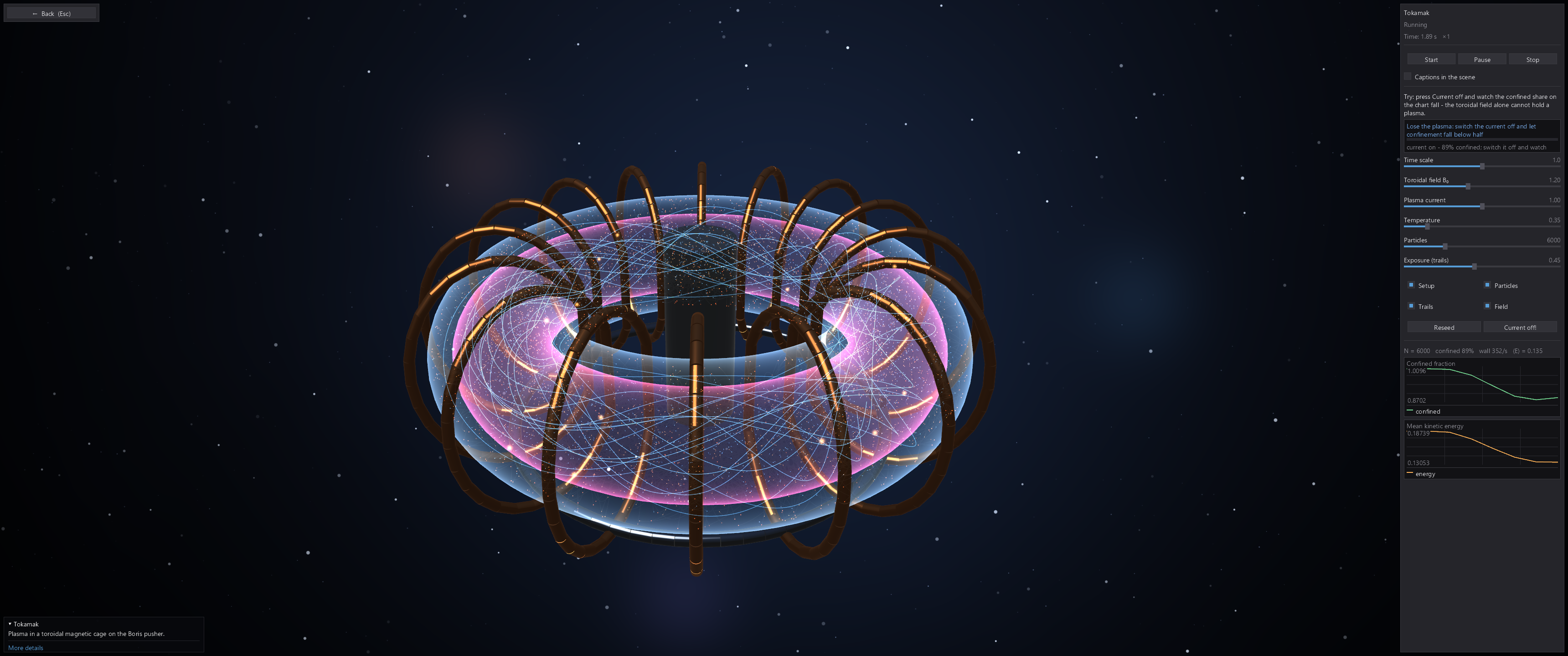
Fixes: the tokamak vessel was lying 90° off its plasma; cloud-chamber tracks took their length from the full range instead of the chamber; the electron-optics plates were silently capped at ±400 V while the slider said ±1500; the turbulence lab on OpenCL read a buffer nobody had written; several charts kept accumulating while paused; ten modules were leaking GPU buffers each time you closed them.
Posted by the game’s developer or publisher to its Steam community hub and published by Valve through Steam’s public news API. Sifter reproduces it unedited and writes none of it.