IKANDY 1.6.23: Motion control, the full guide
IKANDY moves every visual with your music. One Motion window holds all of it: the Look every scene gets, and your moves on the beat. It works the same way on every kind of visual, from the built-in worlds to MilkDrop presets and the shaders you import. No move ever shows past the edge of the picture, and Intensity 0 stops all of it.
New in 1.6.23
- Speaker, a fifth move: the whole screen pumps toward you on each kick and springs back past rest, like a speaker cone.
- The Motion window: one MOTION button opens the Look and your moves together, and every change applies as you make it.
- Bass, Mid and Treble light the Look: Bass lights the picture, Mid colours it and Treble makes it sparkle, on every scene that takes a Look.
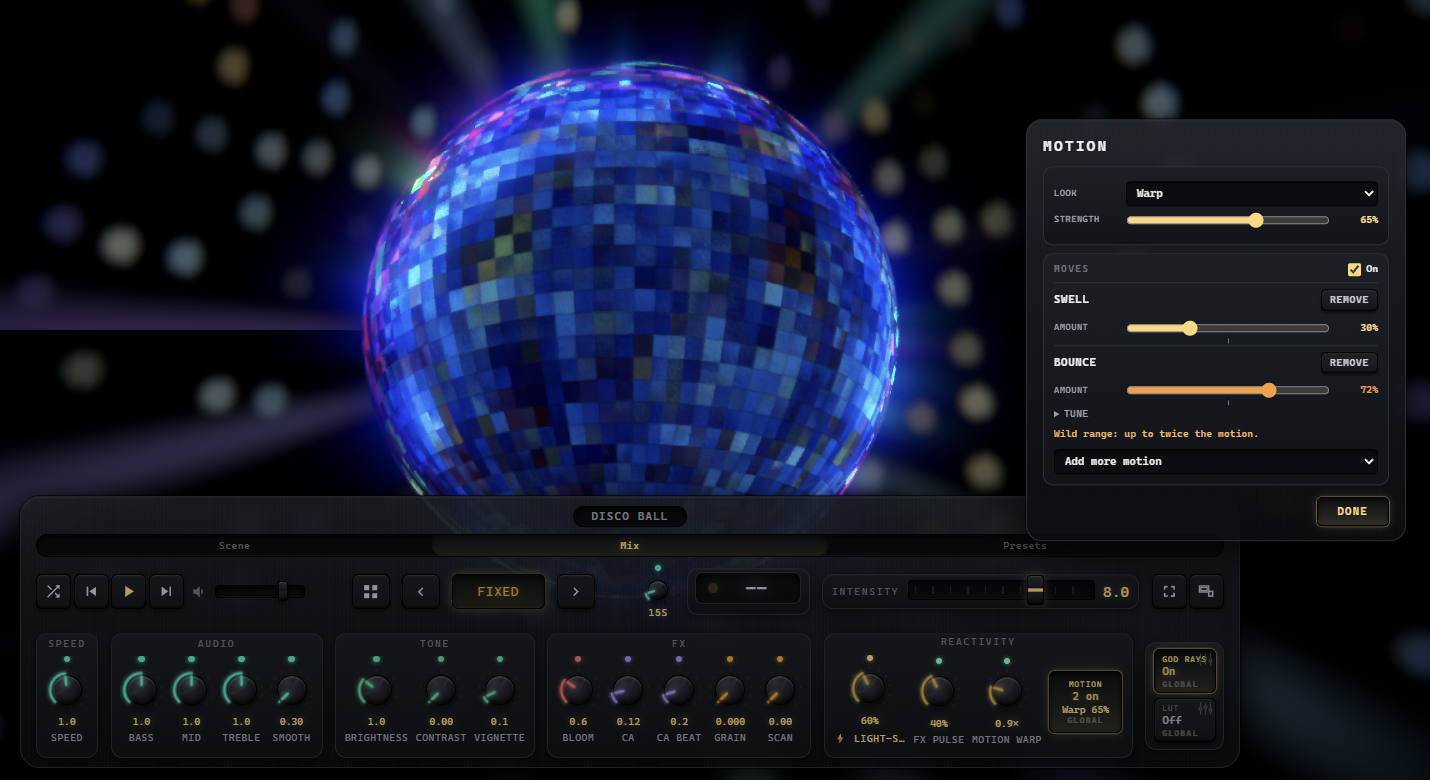
Open the Motion window
- Open the DJ Console and find the Reactivity panel. MOTION sits beside the Light-Sync, FX Pulse and Motion Warp knobs and shows what is on: your moves (a name like Swell, a count like 2 on, or Off) and your Look (like Warp 65%). It lights up while either is on.
- Click MOTION, or Tab to it and press Enter. The window opens at the right edge of the screen, so you can watch the picture while you tune it.
- The Look is at the top and your moves are below it. Every change applies right away and carries to every scene. Press Done or Escape, or click outside the window, to close it.
The Look
The Look is the musical treatment every scene gets. Pick one and set its Strength, from a whisper to the full effect; it starts at 65 percent.
- Original: each scene exactly as its author made it. This is the off switch.
- Subtle: a gentle breath. Bright shapes swell softly with the bass and warm a little on detail.
- Flow: bands of colour travel across the picture with the music's swell. Colour moves; brightness stays put.
- Impact: a ring of light bursts out from every kick and snare, tinted by the picture's own colour.
- Warp, the default on Pro and Studio: every kick and snare sends a ripple through the picture itself, which lights up along the wave and shimmers. Nothing is drawn on top, so dark scenes stay dark.
Pictures, videos and games have no Look, and the window says so.
Bass, Mid and Treble: a lighting desk
With a Look on, the three Audio knobs light the Look on every scene that takes one, compute, WebGPU and MilkDrop scenes included.
- Bass lights the picture: the Look's light and its rings follow the kick and the sub.
- Mid colours it: the Look's colour follows voices and most instruments.
- Treble makes it sparkle: the colour fringes on the hats and cymbals, and the shimmer on each ring.
At 0 the Look drops that part of its light, and 1 is full. Above 1 the visual itself reacts harder, while the Look's light, colour and sparkle stay at their full 1. The moves follow the beat itself, so these knobs never stop them.
The five moves
- Swell: the centre object grows on each beat and settles, in 2D and 3D scenes alike. It is on at 30 percent from the start.
- Bounce: the subject stretches as the beat comes, squashes on it and hops on the rebound.
- Punch: the whole picture pushes toward you on each hit.
- Drift: a slow glide and zoom that follows the song.
- Speaker (new): the whole screen pumps toward you on each kick and springs back past rest, like a speaker cone. It zooms the picture in a little to leave room for the spring back. It is the strongest move, so start it low.
Swell and Bounce look for a subject, such as a fractal, a disco ball or a logo, and move only that part while the rest of the frame holds still. A picture that fills the screen, like most MilkDrop presets, has no subject to swell: Bounce pulses it as a whole instead, and Swell leaves it still.
Add, stack, tune and remove
- Choose Add motion below your moves (it reads Add more motion once a move is on). Hover a move's name to see what it does.
- You can stack all five. Moves that move the same thing share one budget, so stacking changes the character of the motion rather than piling it higher. Speaker keeps its own.
- Each move has one Amount slider. Up to 50 percent, the tick on the track, is the standard range. Above it is the wild range: up to twice as much motion, with an orange readout and a note, because it can be too much for some people. It is never a default.
- Open Tune under Bounce for Squash (how much it flattens on the beat), Hop (how high it jumps on the rebound) and Focus (Auto finds the subject, Centre object always moves the middle, Whole screen pulses the full frame).
- Remove takes a move out. The On switch at the top of the moves turns them all off and back on without losing your settings.
On the beat
- Motion follows the beat IKANDY predicts, so each hit lands on the music instead of chasing it. A build gathers, and a drop lands big.
- On slow songs, where a bar long rhythm could sway the whole picture, Motion holds itself back.
- Wireless headphones or a TV that plays the sound late? Open Settings, AUDIO, Picture timing and slide the picture later until the dot pulses with the beat you hear, or tap along and IKANDY sets it for you.
Turning it down or off
- The On switch in the Motion window turns the moves off and keeps your settings.
- Intensity 0 stops all of it: every move, and the Look's reaction to the music.
- Settings, AUDIO has the same controls outside the console: Motion for every scene (its Motion on switch) and Look for every scene (Original turns the Look off).
The Motion window works from the keyboard (Tab moves through it and Escape closes it), and a screen reader hears what MOTION has on.
Free, Pro and Studio
Free includes the Swell and its On switch. Pro and Studio add Bounce, Punch, Drift and Speaker, stacking, Tune and every Amount, and every Look; on Free, every scene plays as its author made it (Original).
The full guide is in Help (F1), Field Guide, Motion on the beat, and on the web at ikandy.app/guide/motion.html.
Posted by the game’s developer or publisher to its Steam community hub and published by Valve through Steam’s public news API. Sifter reproduces it unedited and writes none of it.