Something I think has gone over fairly well with Dread Admiral is the ship balance. While I've applied various buffs to the escorts and Submarines, the balance hasn't changed all that much from playtest to post-release.
--- The Starting Point ---
Dread Admiral is an homage to The Grandest Fleet, so the initial ship types (indeed, at time of writing - all of the ship types) are directly inspired by GFleet and many of their stats stayed the same. Part of this is to ensure that an old GFleeter will see things they remember and get a similar experience, and part of it is that it was reasonably well designed - albeit Battleships were a bit too spammable in the original.
--- Initial Balance Procedure ---
When I've determined what a niche for a unit is supposed to be, or if it has a niche, the first thing I do is go through a manual process of determining a cost-to-cost comparison of how the unit stacks up to others. It sounds a bit silly, but it allows me to see if the unit stacks up or not.
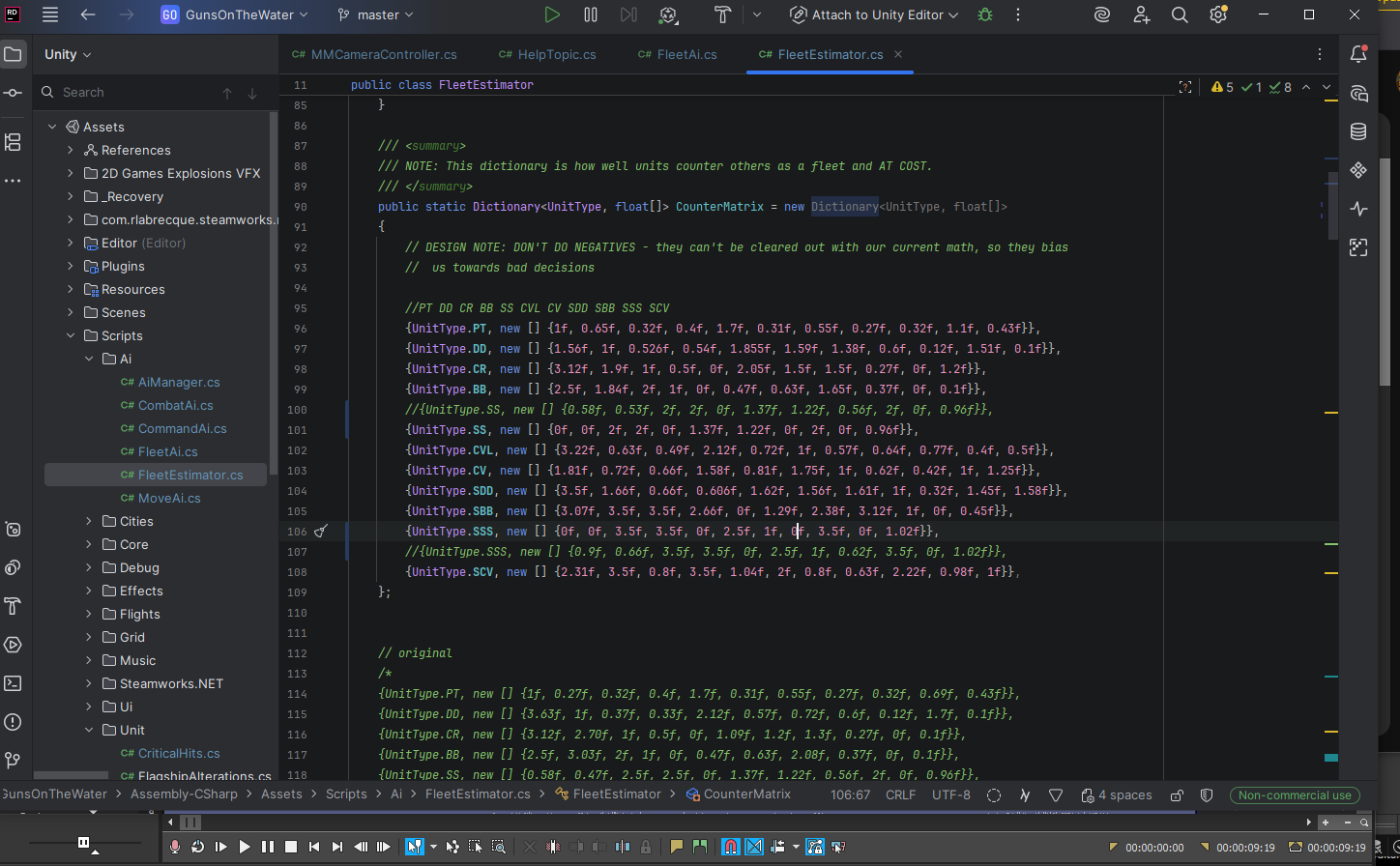
Let's look at the Carrier vs Battleship, a prime example that is quick and easy. The Carrier is more expensive at 47, so it'll get a 43/47 multiplier on its score.
If the Carrier goes first:
Carrier deals 10 (BB at 20)
BB moves up, deals 6, takes 10 (CV at 7, BB at 10)
Carrier moves back, deals 10 - BB dead
If the BB goes first
Deals 6, takes 10
takes 10
Deasl 6, takes 10
So barring crits, damage variance, an undue amount of Flak casualties, or similar, the two (in a vaccuum) are largely balanced, but the CV will always win, with an average of 4 HP left. This is why the initial game was purely a cost-to-cost balance procedure, and why I am often hesitant to make many changes to the actual stats of units - they have been balanced delicately for Skirmish mode.
If you run the Calculations above with Cruisers you'll see that the 4 Speed vs 5 Speed change from June dramatically increased their effectiveness vs CVLs and CVs, giving them a strong niche as opposed to being completely overshadowed by Battleships. Similarly, though regarding map control, the 4 Speed vs 5 Speed Submarine change allowed them to be much more maneuverable when it came to blockading cities (one of their primary uses.)
--- Destroyers ---
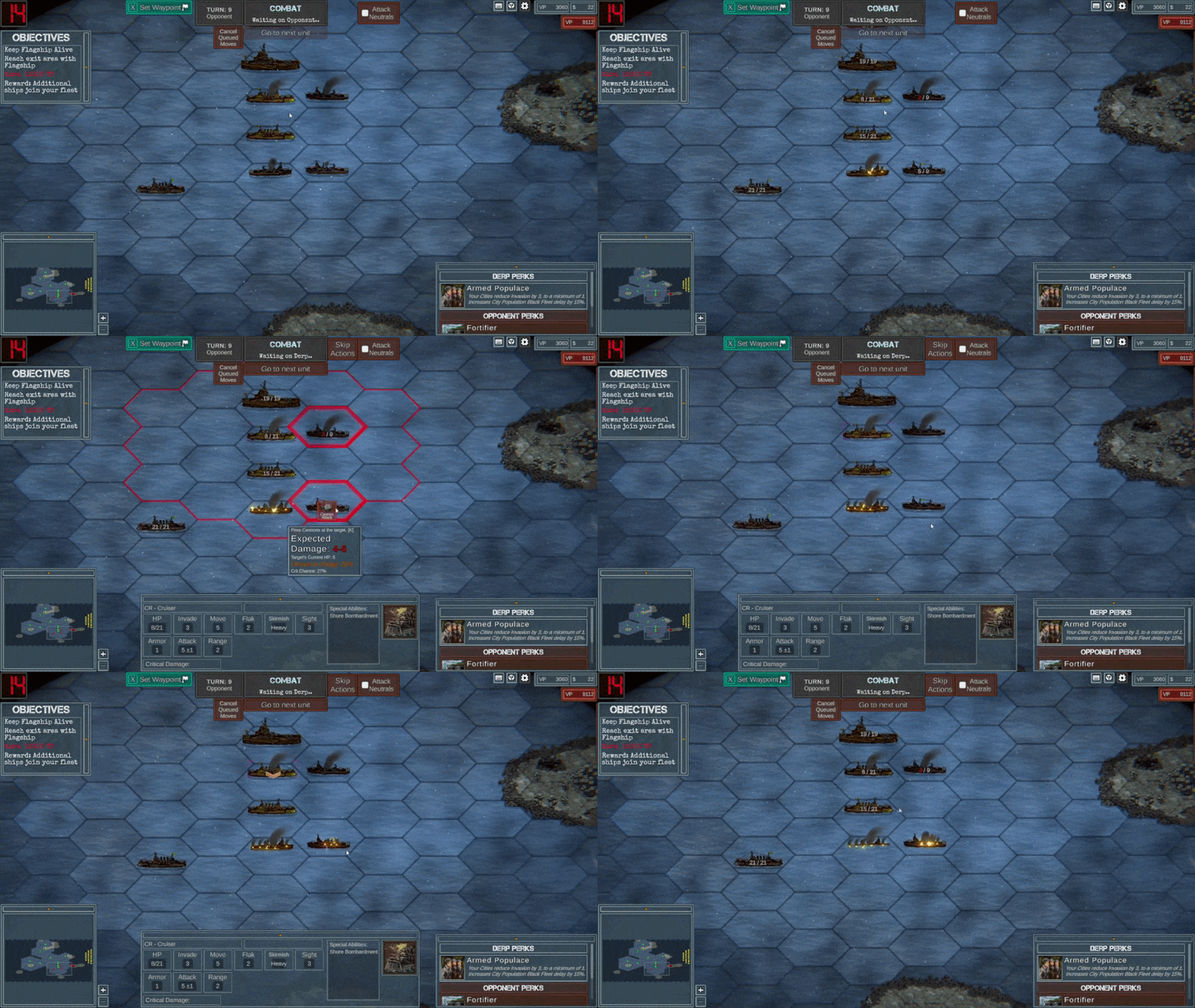
The most frustrating to balance has been Destroyers and Submarines. Honestly, once I bumped DD's to 9 HP I thought they were fine. They pay themselves off with a single Submarine kill and did reasonable damage to Carriers, could nab a kill in the Skirmish phase and still pelt other things, 'nuff said.
But players just don't enjoy them. I've buffed their damage and HP from GFleet. Buffed it again by adding another +1 and splitting it between two attacks (letting them split fire.) I've buffed them again with Hard to Hit, and honestly any more buffs and I think they'll start being too effective against Cruisers/Battleships.
Personally (and anecdotally from others) I tend to build as many as I can almost every map to scour it for subs and replace inevitable losses from the opponent bursting them down. In the cost-per-cost analysis, they are good against almost everything so long as you have the production capacity.
--- Production Constraints ---
A primary issue I ran into in the different game designs between GFleet and Dread Admiral is that GFleet often had many more cities on the map and the change from the several resources managed in GFleet to pure Cash in DA meant that spamming Battleships or Carriers was an optimal strategy.
My first pass to address this was to add the Advanced Shipyard - a limiting factor that gave some time for the early game to breath each map. This helped a lot in pushing the CVL and Cruiser forward as necessary components of Skirmishes especially, but even the early campaign is catered to by weighing whether you can afford/build an Adv Shipyard to pump out larger ships or whether you will simply build more of the lighter ships.
The Secondary Shipyard also emerged from this - largely having the player choose between going with more early/midgame ships and possibly adding an Academy, or trying to push towards the more cost effective Superships. I think this has turned out quite well so far, as the building constraints are just high enough that getting a second shipyard with Superships in Hard/Brutal is difficult in the time constraint and one can often find themselves running out of money in skirmish or the harder Campaign modes.
--- Exit Hexes and Snowballing ---
Naturally, exit hexes became a limiting factor for users. Min/maxing tonnage vs escorts vs Submarines has become a minigame of determining the best fleet comp for the variety of map modifiers or fleets. This was always intended, though the early game missions especially require so few ships (~$150 worth) that I'm still surprised when users express having difficulty with early game maps. Note that filling up exit hexes with $20 ships still leads to (ignoring the FLG) $420 worth of ships, and is potentially doable on Normal.
This particular problem has led to many of the cost increases on Superships and mid-game ships, to try and stagger it a bit so that you don't just steamroll the campaign with Mission 2 Superships (which is still doable, but much more rare/difficult.)
--- Map Modifiers ---
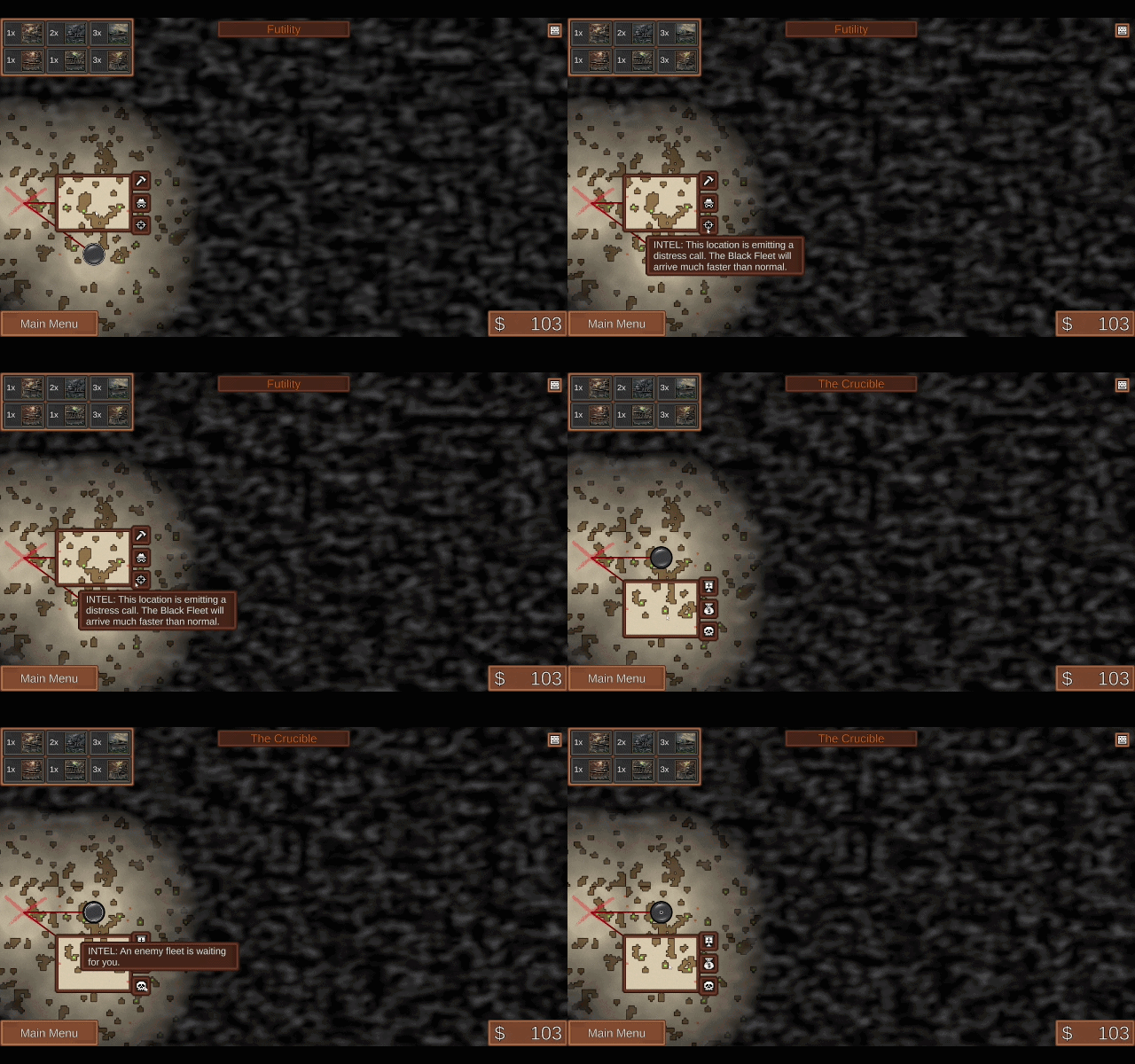
Much of the Campaign's Map Modifiers centered around threatening users that pure Battleship spam would have issues. The Fortified map modifier (Gun Forts) and Wolfpack map modifier (forward Submarines) are both there to help mitigate the Battleship's raw efficiency and help push for a mixed fleet. While Carrier variants are still a tad too effective against Submarines, I think there's a healthy enough balance there to get players to keep escorts around for Wolfpacks, Carriers for Gun Forts, and Battleships/Cruisers to tank damage.
Similarly, the various Admirals were also designed with this in mind.
- The Last Bastion of course is Fortified, but also prefers building gunforts, armored units, and utilized Pillboxes to all reduce Cannon damage, but are all a bit weak to Carrier gameplay. Cautious gameplay should result in this being reasonable straightforward, but reckless gameplay is punished. His flagship runs all brawling upgrades, meaning it's easier to take out from afar and punishes those that rush in close.
- Baptism of Fire focuses on Submarines/Wolfpack to encourage the use of Escorts. Focusing on damage output, he tends to crumble to efficient pickoffs, but the brazen player might fight themselves losing even SBBs to bullish plays.
- Pulling Rank uses Aerophobia, runs double Flak cannons on the FLG for even more supporting Flak, and prefers building Carriers, often making Carrier focused strategies more difficult due to the high attrition on your fighters and makes it more likely that you'll need to group up your forces for a large push rather than attrition based gameplay.
- Legacy of Iron punishes the defensive player by giving a more significant economic advantage to the AI - making matching their production difficult.
--- New Ships ---
While I won't expound on this too much, there are niches unfilled that will offer players new options when Big Updates roll out. BU#1 in mid-fall will have two options that are efficient vs mid-game ships and potentially even superships, but rather weak to the early game ships cost-for-cost. These variants should present interesting new elements for the mid-game and give you more options for both long range attacks as well as options for supporting the fleet.
Posted by the game’s developer or publisher to its Steam community hub and published by Valve through Steam’s public news API. Sifter reproduces it unedited and writes none of it.